In the Fall of 2021, I enrolled in a writing class through the Capital District Genealogy Society. The program was in response to members’ needs to find ways to memorialize, describe and contextualize the artifacts they were collecting in their genealogy research. The class had a wonderful teacher in Paul Lemar. He has a gentle and coaching teaching style and inspires his writers, so they push beyond their perceived limitations to simply be brave in the face of a blank page. He has helped to shape my writing, the format of this blog, and for this he has my deepest gratitude! Thank you, Paul.
Ellen McCauley Aunchman (1885-1966)
Apart from cousins, with whom I had grown up with, as well as a few aunts and uncles, I had little knowledge of the origins and the scope of my father’s paternal lineage. After my retirement from public service, I began using an on-line genealogy product to explore that unknown mystery. In the spirit of a grade school science project, I swabbed my mouth inserting the sputum and cell matter into a test tube and then carefully packaged and mailed the contents to a high-tech DNA lab to be processed. Those results verified what I generally knew. I am predominantly of Irish origin (83%), with some Scottish, Norwegian, and Polish, sprinkled in like paprika on a potato salad. In the past year I was advised by the company that due to new participants from the larger sample of humanity, that I was now only 77% Irish. I appear to be becoming less Irish with each passing year, statistically speaking.
This genealogy treasure hunt has led me to discoveries that were under my nose. My first real research breakthrough was identifying the correct McCauley household that appears in the 1901 Irish Censes for Fermanagh County, Northern Ireland. At that time only four of the ten children still lived on the farm on New Tate Road. One of them was Ellen McCauley. According to that censes she was 18 years of age, Catholic, unmarried, she could read and write, and her occupation was that of a dressmaker.
I shared the results of my research with my father’s sister, Patricia. In a matter-of-fact conversation style aunt Pat informed me that “Oh yea, that is your aunt Ellen Aunchman, your aunt Gladys’s mother. She died in the sixties. She is buried close to your parents, near to the road the other side of their section.” I vaguely remember someone pointing that out to me at my mother’s funeral. Overwhelming grief tends to bury smaller, but not less important, memories. A thought took hold that this person who was represented in the 1901 census form, who was born in Northern Ireland around 1883, was buried in the same cemetery as my father in Rensselaer, NY. I didn’t remember my father speaking about her, except a mention or so when my grandmother, father and aunt Pat were reminiscing during family parties. I wonder if my parents’ choice of their grave site, particularly my fathers, gave him a sense of comfort knowing he would be buried near some of his Irish kin.
As my mother had died the previous fall, the next spring I began a new ritual of visiting my parents grave, tidying the base by removing grass and debris, and adorning the two vases that bookended grave marker with new artificial flora. When that was completed, I began to search for Aunt Ellen’s gravestone. I combed the rows of stone and finally there it was in large letters, Aunchman. Inscribed underneath the family name was Ellen McCauley’s name and a date of birth that was close enough to match. I introduced myself, though I didn’t speak out loud for fear people would think I was touched. “Aunt Ellen, I’m Keith McCauley, Bernard’s son. The second oldest of his and Marilyn’s. You were alive when I was born, but I don’t have any memories of meeting you. I would have been around 4 years old when, well you know”. I only recently discovered you were in the area, and since I was checking in on my parents, I thought it best to come over and introduce myself. Well, you surely came a long way to be buried here. When I was in high school, I used to ride my bike past this place often. I knew grandpa was here, but I didn’t know you were. Well while I’m here let me polish this stone up a bit. I’m going to go now, God bless you.”
As I turned to go back, I noticed the name Froelich on an adjoining grace marker. Given the name and date I believed it to be Ellen’s Grandson. Robert Froelich and my father were good pals when they were growing up. They would go camping, hiking, and fishing with other boys their age. I never realized he was buried so close to my father. He surely must have known that when he purchased the burial plot. I felt a little diminished for never realizing this earlier; particulars such as where and when people were buried, the significance of certain relationships. My lack of awareness of such details at times seems to be as thick as a gravestone. Yet, time wears down the stone and offers small revelations.

As my research continued, I found out more facts about Aunt Ellen’s life and one night found her in a photograph on a distant relative’s family tree. The composition of the photo is of John Aunchman Left, and Ellen Aunchman on the far right. There is no date associated with the picture, but the clothing seems to resemble styles worn in the 1930’s. The man behind the rocking chair resembles my grandfather. If that is true, then the child in the rocking chair would quite possibly be my father. The photo may have been taken at John and Ellen’s home at 21 Nelson Avenue in Rensselaer, NY. The stoop in the photo has a similar profile to the structure still standing there today. Bernard (III) and Anna McCauley lived close by at 321 Columbia Street in 1935. Ellen appears a little thin and tired. Is that a hint of sadness in her eyes or is it the presence of depression that flickers around the narratives in some of my family member’s lives?
As my research continued, I found out more facts about Aunt Ellen’s life. The family seemed to move frequently. Ellen persisted with that trend long after John’s death in 1938. Her most consequential move was from Newtate Road, Fermanagh County, Northern Ireland, a very rural setting, to the bustling city of New York in the United States. An exodus from a country in decline to a land of hope and promise. The trip had all the potential for excitement, but was the change also overwhelming? Was she on the move away from death?
There was the death of Ellen’s brother John in 1888 at the age of sixteen. The records suggest he may have been injured or disabled for approximately a year before his death. She would have been a small child at that time, living with a convalescing brother in rural Ireland and with a large family busy running a farm. Did Ellen feel that she was still running after the death of her father, Bernard, in 1902? Although that would have been shortly after Ellen had left for American.
The deaths of workers at the Triangle Shirtwaist Factory Fire in 1911? Ellen and John Aunchman were living in the Bronx at the time of that horrible fire. Ellen had previously been a seamstress at the Earl of Enniskillen’s Florence Court estate while she was living in Ireland. The Triangle Shirtwaist Factory Fire was a tragic national news story. One Hundred and forty-six women died as they were locked in the factory and could not escape. Some leapt to their deaths to avoid the flames only to be impaled by the iron fence below, or not survive the trauma of the fall. Ellen was a seamstress herself and an Immigrant. Did she feel sympathy for the plight of her fellow garment workers?
Ellen would have lost her older brother in 1914. Phillip McCauley was a bricklayer who was living in Brooklyn at the time of his death. He would have been one of the first siblings to emigrate from Ireland. Other siblings had stayed with Phillip when they arrived in the country. Another brother, Edward, a police Patrolman in the Bronx NY, dies of Pneumonia in March 1917. His wife Nelly succumbs to pneumonia later that same year.
Ellen experiences the very intimate loss of her youngest daughter in 1916. Eileen Aunchman was three years old when she died of pneumonia and meningitis. There would have been little time to grieve, with her daughter Gladys, aged 6, and son Vincent age 4 to rear. Vincent was born with a slight palsy and walked with a gait and had difficulties with speech articulation. Raising a child with disabilities is always a challenge for a family. In those days there would have been an implied moral failing and no resources to assist a parent in educating them and helping them to adjust and live a fulfilled life.
Another consequential loss was that of her sister-in-law Susan Reilly McCauley in 1918. Susan’s death paired with Ellen’s brother Bernard’s accidental disability, led Bernard McCauley (III) and his brother Thomas’s to be admitted to the Orphanage at Mount Loretto, or the Mission of the Immaculate Virgin. Ellen would visit them with their father, Bernard (II) until he passed away in 1923. Family stories indicate that a sea captain was interested in adopting both Bernard and Thomas, but Ellen would not hear of it. She stayed in contact with the boys until they became of age to be released from the orphanage as adults. Family stories indicate that Thomas would live with Ellen on and off through the years.
If the 1910 Censes is accurate, Ellen McCauley married John Aunchman in 1907. He originally was from Vermont and was working in the city as a Milk Salesman. I wonder if John used his rural dairy experiences to market and coordinate sales and deliveries from upstate dairies. Could their move be attributed to upward mobility and trying to locate the best neighborhood in the Bronx? Across the river, in New York City, there was great disparity from very wealthy neighborhoods to run-down tenements. There was room in the Bronx for residential expansion and the bridges, ferries, and trains were beginning to make it possible for people to work in the city and live in the outer boroughs. In 1920 The Aunchman’s moved to Vermont. This would have been the fifth move during a ten-year period and then in 1930 a move to Nelson Avenue in Rensselaer, where Ellen would live for a stable stretch of approximately 10 years.
During those years Gladys would marry and start a family. Vincent would grow to be 6’ 1’’ tall and work as a laborer eventually settling into his own business as an “Ash Man”, cleaning furnaces and boilers and removing the ash. He would later contract small trucking jobs. He married Thelma Face in 1936 and they lived in Rensselaer, eventually purchasing a small property on Best Road in East Greenbush, Rensselaer County, New York. Vincent appears to have achieved quite a bit in the face of his personal struggles, but the social stigma’s related to his disabilities may have stayed with him throughout his life.
I remember being around seven or eight years old and along with my other brothers receiving an appropriate dressing down from my mother regarding our free use of the word “retard”. At that age we would frequently taunt each by calling one other “retard” if we knocked over, spilled, slipped, tripped, mis-spoke, mis-counted, or mis-executed a sports move. This word would also freely be used, if we got too close to each other, sneezed, breathed, burped, farted, or God Forbid, touched each other. My mother, usually a more reserved and calmer person, became very agitated with us. She said she could no longer tolerate the use of that word in the house. She explained to us that being retarded was a serious condition that required our understanding and sympathy. To call someone a retard was as bad as cursing them. There were people in the world who were different and did not deserve our scorn but our sympathy and understanding for their struggles. With my father close-by she explained to us that we had a cousin who had disabilities and that if not for the “Grace of God”, we could also be disabled. Our cousin had struggled due to mean and uncharitable comments. We had to be better, more mature, and understanding people. The news that we had a disabled cousin surprised me. I had no idea. My father silently nodded his head. In the end my brothers and I had to agree to never use that word as a slur or to tease on another. We never really heard much more regarding our disabled cousin. That thought got lost in the day-to-day life of childhood.
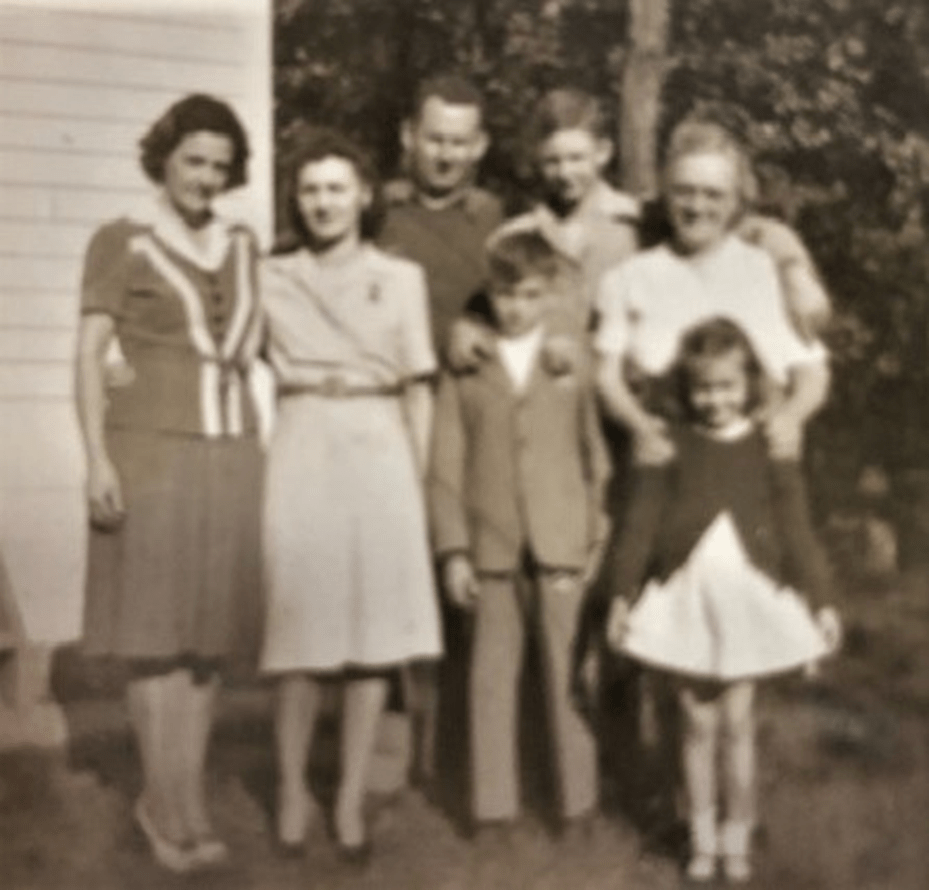
As John Aunchman passed away in 1938. Perhaps Ellen felt a sense of purpose during the Years of World War II. The photo below was taken in the summer of 1942. My Grandfather would have been fighting in the Philippine Islands. Gladys Froelich, Ellen’s Daughter, is on the left next to my grandmother. Both seem to carry the worries of the war and the day. Robert Frolich is in the center, and next to him is his son Robert, Jr and then Aunt Ellen. Her smile seems more relaxed as if she has found solace and purpose in the family during the war. The two small children are my father, Bernard (IV) and my Aunt Pat. The Picture seems to be the calm before the storm. After the second World war Aunt Ellen moves 10 times in an 18-year period including a trip to Ireland in 1947 in which she unsuccessfully tries to set up residence on Newtate Road in Ireland. My aunt Pat reports that she complained there was no running water, or reliable heat and that there were chickens and other animals over-running the property. She had placed an overseas call to her daughter Gladys to assist her in planning for her immediate return. My Aunt Pat confirms that Gladys bore the responsibility in assisting Ellen with her many re-locations and passed an understated comment that there were times Aunt Ellen could be quite demanding and had a quick temper.
One night while following up on more “hints” regarding my ancestry I came across the following article on Vincent Aunchman from the September 16, 1964, issue of the Troy Record.
Vincent J. Aunchman, 54 a self-employed trucker, was found dead of
a gun wound in the head in a garage at his home on
Best Road, town of North Greenbush, about 5:30 p.m. yesterday.
Coroner Ira D. Van Wormer is withholding a formal decision. He directed removal of the body to the William J. Rockefeller Funeral Home, 8 Second Ave, Rensselaer.
Mr. Aunchman was born in New York City and had resided in Albany and Rensselaer. He had lived in Rensselaer for 25 years before moving to his present residence two years ago.
For many years he was in the trucking business which he conducted himself.
Mr. Aunchman is survived, besides his wife, by his mother,
Mrs. Ellen Aunchman, who resided with her son; a sister, Mrs. Robert Froelich,
and a nephew, Robert V. Froelich.
Months later comes the spring, I am back at the cemetery visiting and switching older bouquets for new floral arrangements. There is also some light cleaning and polishing. Standing in front of Ellen’s grave, I am remembering all the things I have learned about her with a mixture of emotions. One of the things I have learned about her that I do not care for is her temper, but I see that same quality in myself and understand it becomes stronger during times of stress or grief. I am not sure if she was strong, but she seemed determined. I do admire determination. I also admire the courage that one needs to take a big chance or courage that sometimes one needs to face a new day.
I find myself saying that I had found out what had happened to Vincent. “I don’t understand the circumstances, but it must have been awful to experience.” Were things said in anger that ultimately were too much to bear? Were there high expectations that were intended to guide a young Vincent with disabilities, and an intensity to that instruction that did not let up over time? No one will know for sure. I share with her that in my career, I worked with individuals with disabilities teaching them to care for themselves and offering support and assistance to lead fuller lives. The work is not always easy and straight-forward. For me this work was an advocation, but to you it was a daily part of your life, one you could not avoid. “Ellen, I hope you were able to find some reconciliation before you passed way.”
Up the hill on the far side of the Cemetery, I located Vincent’s gravestone. The cross on his stone is engraved at an angle. I wonder if this is a representation that he took his own life. I begin to brush away the dead grass at the base of his stone. I notice there is not a carving to identify his wife, Thelma. I remember learning that after his death, she remarried and moved out of the area. She will not be joining him in the plot, I don’t say anything regarding that, but I think he has already figured that out. I don’t know what to say to him. I can’t say that I ever remember meeting him, but his life experiences seemed to silently influence my career as a helper and advocate for people with disabilities. Perhaps my work can offer some honor to his memory. “It must have been terrible for you to feel so badly that only solution was to end your life.” “I hope you have found some peace. I hope you were able to forgive” and finishing the prayer “and forgive those who trespass against us….”
As I drive down the hill out of the cemetery, I take note of how many relatives are buried in Holy Sepulcher cemetery. The family now in stone and shadow. Aunt Ellen McCauley Aunchman and her husband John. Ellen’s final stop on her journey from Ireland. The rest of this family in this sacred space; Bernard McCauley (III) and his wife Anna, Robert Froelich, Ellen’s Grandson. Also, there is Thomas McCauley, Bernard McCauley (IV) and his wife Marilyn, my mother. (I think my mother is a saint as she will be putting up with the lot of them for the rest of eternity!)
 Four Bernards & Their Clans
Leave a comment